Leadership Development Options Compared: Cost, Effort, Impact
I run a mentoring company. So when somebody asks me how they should develop their leaders, you can probably guess what I am going to suggest.
That bothered me enough to do something about it.
I wanted to know where mentoring actually sits against everything else an HR or OD leader could buy. Not where I would like it to sit. Where it sits.
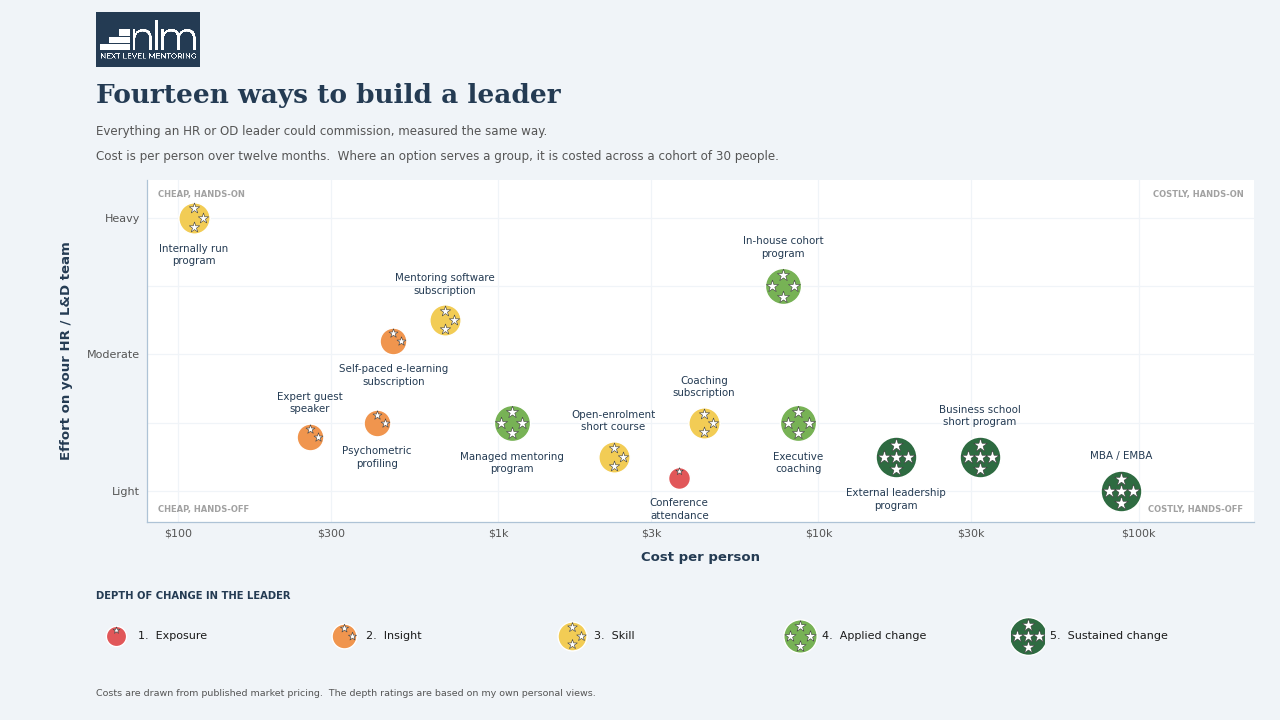
So I put fourteen leadership development options on one chart and scored every one of them the same way.
- Conference attendance
- Expert guest speaker
- Psychometric profiling
- Self-paced e-learning subscription (LMS)
- Internally run program
- Mentoring software subscription
- Open-enrolment short course
- Coaching subscription
- Managed mentoring program
- In-house cohort program
- Executive coaching
- External leadership coaching
- Business school short program
- Postgraduate degree
How fourteen leadership development options were compared
Three things get measured; cost to implement, effort to run and depth of change of the participant.
Cost to implement per person.
The catch here is that most of these options are priced completely differently. Some charge per head. Some charge one fee for a booking regardless of how many people are in the room. Some charge an annual platform fee that barely moves whether you put thirty people on it or three hundred.
So I fixed the group size. Everything is costed as though you are developing thirty people. Thirty is a sensible number. It fills a room, it is a realistic cohort, and it is small enough that most organisations could actually fund it.
This matters more than it sounds. A guest speaker looks cheap when you spread the fee across two hundred people and expensive when you spread it across ten. Software looks almost free at five hundred users and much less so at thirty. Fixing the number is the only way to compare like with like.
Cost does not include cost of your own resources, purely external costs. Your own resources is covered under Effort.
Effort on your team to run.
Not the participant's time. The time your HR or L&D people have to put in to run it. Some of these initiatives you approve and forget. Others become somebody's second job for the best part of a year. Ranked from light to heavy.
The depth scale: five levels of change in a leader
There are five levels, and the names describe what actually changes in the person.
Exposure. They encounter ideas they had not met before. Nothing more is claimed.
Insight. They understand themselves or their situation better. This is real and it can last for decades. It is still not capability.
Skill. They learn something they could do. Whether they do it is another question entirely.
Applied change. Behaviour actually shifts in the real job.
Sustained change. The shift holds after the thing stops, and it often spreads to other people.
What I left out, and why
The test I used was simple. Could an HR or OD leader raise a purchase order for it, or otherwise deliberately commission it, as a complete answer?
That knocked out a few things people expected to see.
Stretch assignments and secondments did not make it. Not because they do not work. They probably work better than anything on the chart for developing leaders This falls into the 70 in the 70/20/10 model. But they are created by business need rather than by HR. A role falls vacant, a strategic project needs a lead, someone goes on parental leave. You cannot put a start date against one, and you certainly cannot invoice for it.
I also left out 360 degree feedback, which is a common tool for showcasing peoples strengths and blindspots. It is an ingredient to other programs and almost nobody buys one and stops there. If they do, it can go badly wrong. I know of several cases where anonymity gave people licence to be genuinely nasty and it set the person receiving it back months. A 360 belongs inside a wider program where the results can be properly worked through.
There will be many other leadership development initiatives out there that could and may be mapped in the future. If you see an obvious gap, then please get in contact.
The caveat
Now the caveat, and please do not skip it.
Every one of these ratings is an average. Every single option on this chart has been life changing for somebody. And every single one has been a complete waste of time for somebody else. I have watched people come back from a one hour session with a guest speaker and change how they lead. I have watched people sit through a year long program and change nothing at all. The rating describes what the option tends to produce across a group. It does not predict what it will do for any individual. Anyone who tells you otherwise is selling something.
Costs are drawn from published market pricing and are ranges. You will always find outliers out there at either end of the spectrum.
The depth ratings are my own assessment, formed from being part of these programs or designing and running them. People may disagree with some of them, and I would rather hear about it. So please get in contact.
The fourteen leadership development options
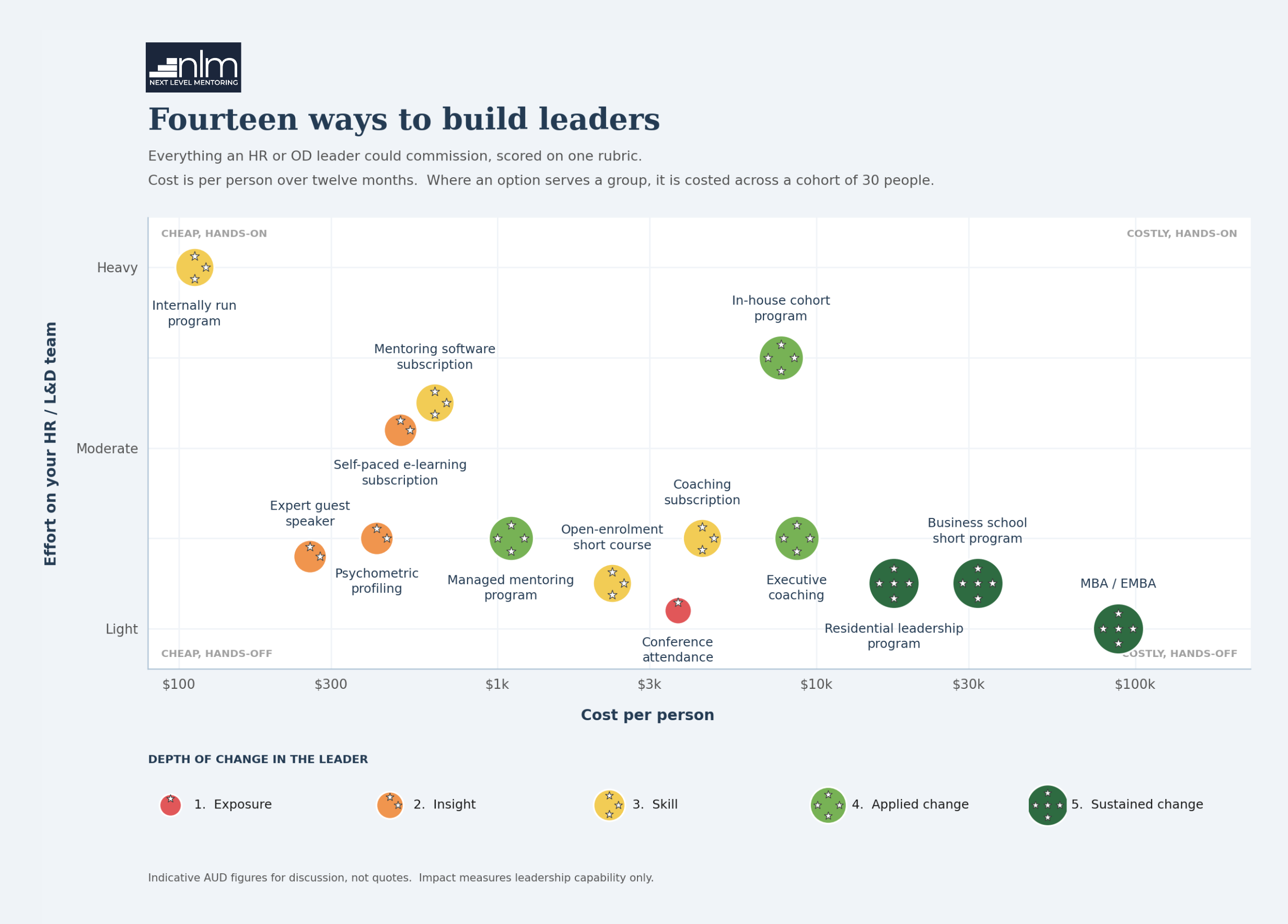
I have grouped these by depth of change rather than by price or effort, because the outcome is what you are trying to achieve.
Exposure
1) Conference attendance.
Sending people to an industry event. Cost is moderate, and higher than most people expect once flights and accommodation go in, particularly if its interstate. Effort is the lowest on the chart, since you approve a request and book a flight. The sessions get chosen loosely rather than against any development gap, and honestly, most of what people bring back has faded by the following week. The networking has genuine value and as a reward to an employee, it can be great. It is just not leadership capability.
Insight
2) Expert guest speaker.
Bringing someone in to talk on a specific topic to a room of your people. Cost per head is the lowest of anything here, and it drops further the bigger the room. Effort is light, since it usually bolts onto a meeting that was happening anyway. A good one genuinely reframes how people think about something live and current. There is just no practice and no follow up afterwards. I have many books from guest speakers that I have never read and the lessons have been forgotten.
3) Psychometric profiling.
Team profiles and personality instruments. TMP, Myers Briggs, PRINT etc. Cost is low, effort is light. I did one of these years ago and I can still tell you my profile and how it boxed me into how I make decisions. That is a good outcome and it has stayed with me. It did not make me better at leading anybody. It builds awareness rather than capability, hence why it doesn't score higher in depth. I say that as someone who found it genuinely useful.
4) Self-paced e-learning subscription.
A content library your people can work through on demand. These are sometimes called Learning Management Systems (LMS). Cost is low. Effort is higher than people expect, because procurement, integration, single sign-on, curating what people should actually watch and then chasing completions is a real project rather than an admin task. The content often aims at skill. The problem is that most people never get there, because nobody carves out time in their week to properly go through these, and it slides.
Skill
5) Internally run program.
You design and run it yourself, using your own people. Could be mentoring, could be a leadership series, could be anything. Cost is the lowest on the chart by a distance because you are using your own resources. Effort is the highest, by a similar distance. And that is the whole point of including it. The cheapest option is not free. It is paid for in your team's time instead of your budget, and somebody has to actually do it who may not be an expert in that area, hence why it doesn't score higher in depth.
6) Mentoring software subscription.
A platform that handles matching, scheduling, reminders and reporting for a mentoring program. Cost is low. Effort is moderate to high, and this is the bit that catches people out. The software takes the logistics so suits large programs (150+ people). It may provide training but doesn't follow up to ensure the lessons have stuck. It doesn't design your program, run your kick off, or step in when a pairing goes quiet in month three. You are buying tooling and keeping the job. Due to this there is a higher percentage of mentoring pairs that do not last longer than 6 months, hence why depth is averaged out to be 'skill' and not 'applied change'.
7) Open-enrollment short course.
A public program you send one or two people to. Cost is moderate, effort is light, and a good one teaches something specific with practice in the room. Whether it survives contact with the day job is exactly the open question.
8) Coaching subscription.
A platform giving people access to real coaches, at whatever scale you want to buy. Cost is moderate per seat. Effort is light once procured and integrated, because deploying it easily is the entire selling point. The catch is that you pay per seat whether somebody books fortnightly or never opens the app, and a meaningful share of people do not stay with it in the medium to long term.
Applied change
9) Managed mentoring program.
This is my area of expertise, so read it with that in mind. Structured mentoring with the design, matching, mentor training, goal coaching and support built around it. Cost is low to moderate. Effort on your team is light, because you are paying for expertise to run it. Like everything else here that goes deeper than a single session, it runs across the best part of a year, and the breakthroughs land once pairs have met a few times, and relationships normally stick long past the program formally ends. What it does need is experienced people inside the organisation who want to mentor so may not suit small companies.
10) In-house cohort program.
A provider delivers a curriculum to your people, in your building and across modules spread over six to nine months. Cost is high. Effort is heavy, and I think people underestimate this badly. You are hosting a series of events, selecting a cohort, scheduling around senior diaries, chasing attendance and keeping a sponsor interested. The spaced design is genuinely good for making things stick. You just do a lot of the work to get there.
11) Executive coaching.
One to one, tailored, usually six to twelve months and often opening with an assessment. Cost is high. Effort is light when you have selected the provider. It goes deep for the individual and the evidence behind it is solid. But it reaches very few people, it is private by design, and when it finishes there is nothing structural left behind because the coach moves on. Breakthroughs and growth are expected in these packages.
Sustained change
12) External / residential leadership program.
Multi day residential experiences away from work. Some of these take you out into different parts of the state or the country to widen how you see the system you are working in. Others strip your title away and put you in a room with strangers to find out who you are underneath it. Cost is very high, effort is light because somebody else runs it, and the change tends to hold. A friend of mine came out of one completely rewired. They are also now looking for a different job, which brings me to something I will come back to.
13) Business school short program.
One to three weeks at a recognised business school, sometimes across multiple campuses. Cost is very high. Effort is a nomination. At the top end these arrive bundled with teaching, a real project, external coaching and an assigned mentor. I did one of these more than fifteen years ago and I still reference it as one of the best things I have ever been fortunate to go on, which is about the strongest evidence for the rating that I can offer.
14) Postgraduate degree.
An MBA or executive equivalent. Cost is the highest here by a wide margin. Effort on your team is essentially nil, since you contribute to fees and approve study leave. Due to the curriculum of these (which isn't solely leadership content) the durable change comes as much from the cohort, the network and the confidence as from anything taught.
What the leadership development comparison shows
Three things stood out once it was all laid out.
The chart runs on a diagonal. Cheap things cost you time, expensive things cost you money, and depth increases with price. That is not a leadership development insight. That is just how services get priced. But seeing it in one picture makes it obvious in a way that reading brochures one at a time never does.
Everything that produces lasting change is expensive and reaches one or two people a year. All three of the deepest options work the same way. You nominate an individual, you pay a lot, and they go away. Nobody has solved lasting change for a whole layer of leaders at a sensible price. That is the actual gap.
And the worst value on the chart, from a leadership development perspective, is one of the most common lines in a development budget. Conference attendance costs more per head than several options that go far deeper. But the networking, marketing and reward still makes it something that should still be considered by organisations.
How I would read this if I were buying
I built the chart, so I will not pretend I have no view. If it helps, here is how I would use it.
Start with the deepest level, sustained change. It is real, and when a residential program or a business school stint lands, it can reshape someone permanently. But look at where those options sit. All of them are expensive, and all of them reach one or two nominated people a year. You cannot develop a leadership layer that way. It is a luxury for the rare individual, not a plan for a group. Worth doing for the right person. Just not the thing you build a pipeline on.
So drop one level, to applied change. This is the deepest result you can realistically give to a whole cohort rather than a chosen few. Behaviour actually shifts in the job, and you can reach many people at once instead of two. For most organisations trying to lift a layer of leaders, this level is the ceiling worth aiming at.
Three options share that level, and this is where the chart earns its keep. Executive coaching gets there, but it costs several times more per head and still only reaches a handful. An in-house cohort program gets there too, at a similar depth, but it lands heavy work on your own team and runs at the top of the cost range.
And then there is managed mentoring, which reaches the same level while staying cheap per head and light on your team.
That is the argument the chart makes, and I want to be clear it is an argument about efficiency, not superiority. Executive coaching goes deeper for the individual. A cohort program carries more formal content. If you want the deepest possible result for one senior person, buy the coaching. But if the job is applied change across a group, without a fortune and without turning it into somebody's second job, mentoring is the most efficient way to buy the deepest level that scales.
Development and retention
My friend who came out of that leadership program completely changed. They are also now looking for other work, because the program opened their eyes to other industries and what they could be capable of doing, and how much their current employer was holding her back.
That is worth sitting with if you are the one signing off the budget. It is entirely possible to develop somebody so well that they realise they should leave. I have seen it in my own programs. Some of the people who got promoted during them got promoted somewhere else.
Which is why depth of change on this chart measures capability only. Retention usually follows, but not always, and pretending the two are the same thing would have made the whole exercise dishonest.
Develop your people properly and most of them will stay, because being invested in is a reason to stay. Some may not.
But more would leave if they were no development opportunities so its better to have than not have.
Darren McFarlane is the founder of Next Level Mentoring, which designs and runs mentoring programs for government agencies and large organisations. Which means his own service is one of the fourteen on this chart, and you are entitled to be suspicious about where it landed. The DWER case study has the numbers behind that rating. Four years of programs, promotion rates for mentees, satisfaction scores from both sides, and how many pairs carried on meeting once the program formally closed. Read it and make your own call. https://www.nextlevelmentoring.com.au/dwer-case-study
Considering a mentoring program but do not know where to start?
Start a Conversation
Provide your details and we will get back in contact with you within 1 business day.